By Charles Ebert
The world of business writing is vast and diverse, covering thousands of industries and services. Each industry or individual business has its own standards and buzzwords that every proficient writer needs to be aware of before writing any official email, article or memo. Still, business writing, just like any other form of writing has its unique issues and weaknesses, chief among them ignorance and writer’s block.
While some problems are somewhat inherent, there are some that can be traced to lack of awareness, focus or effort on the part of the writers. Some of the mistakes can be very costly to the individual and the business.
1. Using Informal Texting Language
We all have a way of writing messages to our friends, family or colleagues which disregards grammar and spelling rules. With the advent of quick messaging apps such as Facebook Messenger and WhatsApp, most people find it easier to write stuff like “c u @ the mall, xD:-)” in place of the more sensible “Let’s meet at the mall.”
Unfortunately, some people subconsciously use the same language when writing business documents. Depending on the recipient, wrongly constructed or misspelled documents can have serious repercussions including dismissal from work or loss of business. From a business standpoint, it makes perfect sense to hire experienced writers to work on any high-level communication to avoid such mistakes.
2. Including Unnecessary Repetition
Just to make it clear, business writing is not intended to be funny or interesting, unless it’s an ad. The primary objective is to inform or request in the briefest, most precise way possible. Overly repeated words and phrases make your work boring to the recipient, and they are likely to skim through the document or stop reading at once. It is also a sign that the writer is unsure of themselves or doesn’t understand what they are saying. You can avoid all that by:
- Using pronouns when talking about a particular person or item in successful sentences.
- Joining together long sentences using “which,” “where,” etc. when describing the same thing.
- Avoiding modifiers like “small in size,” “red in color” which unnecessarily repeat information.
3. Lack of Proofreading
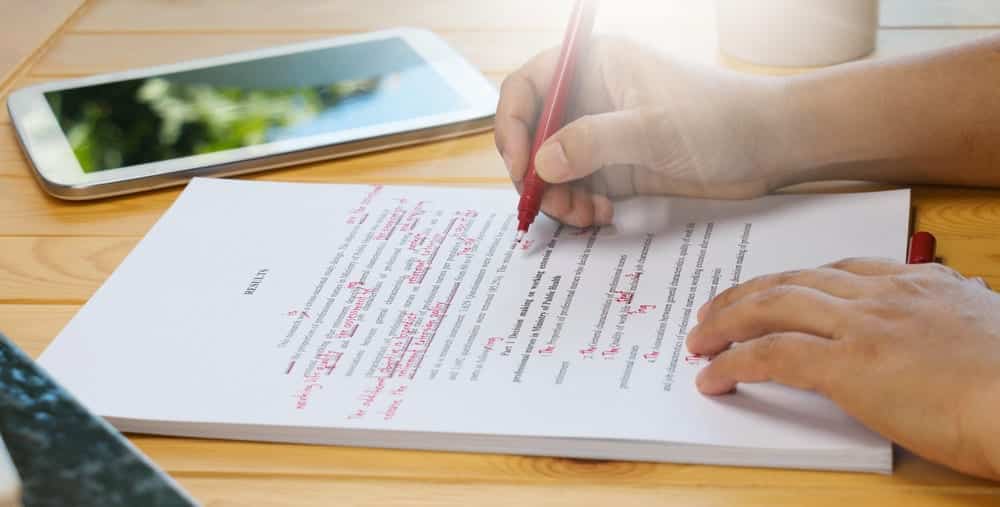
Many people wrongly see it as too much work to reread their emails, notes or memos before hitting the send button. Consequently, they miss lots of typos, grammatical mistakes, incorrect tenses, and unnecessary repetitions. The reader(s) of course won’t miss those and might be left wondering about the writer’s senses. Some pedantic bosses might even decide to punish you for repeat errors which you definitely won’t like.
Writing business content is not the same as writing high school essays. The stakes are way higher. Conducting thorough proofreading after writing every email, article, text or memo will save both you and your reader’s time and mental strength.
4. Switching Tenses Mid-Sentence
Non-native speakers, or writers, in this case, tend to mix up tenses in the middle of their sentences. Many supervisors have been tickled by an apology email going like “Hello, Sir. Unfortunately, I won’t be able to come today as I was not feeling well.” While mostly innocent mistakes, mixing tenses in a sentence can be taken as a sign or carelessness by superiors and might become a subject of ridicule by the general public. Again, when writing for business purposes, check for such mistakes or even better, use grammar software like Grammarly to edit your work.
5. Directly Translating from Another Language
It has been established that more than half of the world’s population is bilingual. However, only a small percentage of people speak English as their first language. Most of these non-native speakers first think in their mother tongue and after that write in English, leaving room for errors in translation.
Since different languages have different grammatical structures, directly translating sentences into English may result in humorous phrases like “Do Not Have Children in the Club” instead of “No Children in the Club.” Such errors may cause undue embarrassment to a business, more so in this age of social media trolling. So, before you write a sentence in a business document, make sure you read it aloud to see if it sounds natural.
6. Missing Spelling Errors
A lot of people have problems when it comes to spelling some words like receive, tomorrow, committee, and accommodation. It is not uncommon to receive an email with “Recieve my gratitude” or something of the sort. Luckily, not many people will notice, but those who do might take it the wrong way, especially if the business involved is a big one. Imagine Walmart sending a marketing email with the words “We belive in quality and convenience…”
Simply put, writing is not only about the content but also the exact words you use to pass on the message. If you feel unsure about the spelling of a particular word, Google it or check in a dictionary. Your readers and even you will appreciate the effort.
Related Stories from Small Business Bonfire
7. Using the Same Old Clichés
It might be due to copying others, but most businesses are guilty of overusing clichés in their written texts. Consider how many times you’ve read the words best practices, high quality, and innovative products. Such words and others have been used in so many business papers that they don’t mean much anymore.
As a business person, you don’t want to make your customers roll their eyes when reading your marketing materials. As such, keep from using common industry buzzwords in your writing and instead look for more relevant words that convey your message better.
Conclusion
In any business context, a poorly written document will often achieve the opposite of what it was intended to do. That is, irritate, distract and bore the reader instead of informing or galvanizing them. The consequences range from lost business, public relations disasters and in some cases, termination of employment.
Conversely, well-written material is pleasing to the eye and mind, and can generate renewed focus among staff and associates. To your customers, it shows professionalism and builds their trust in you. Moral of the story: make sure to proofread that marketing email next time!
- Many adult children remember watching a father work sixty-hour weeks for decades so the family could have what he never did, then watched him die in his sixties without ever prioritizing his own happiness, and now see that same pattern quietly repeating in their own lives, under a different name. - Global English Editing
- Eye tracking research on how people actually read web pages found that most visitors scan in a rough F shaped pattern down the left side of the screen, which is why professional editors front load the real information instead of slowly building up to it - The Blog Herald
- Harvard researchers had 166 undergraduates rate their own pets on qualities like thoughtful, considerate and sympathetic, and the students who felt most chronically disconnected from other people scored their pets meaningfully higher on exactly those three traits, and no others. - Global English Editing
Photo credit: Proofreading with a red pen from Lamai Prasitsuwan/Shutterstock